Published by: electroshop
July 19, 2026
0 comments
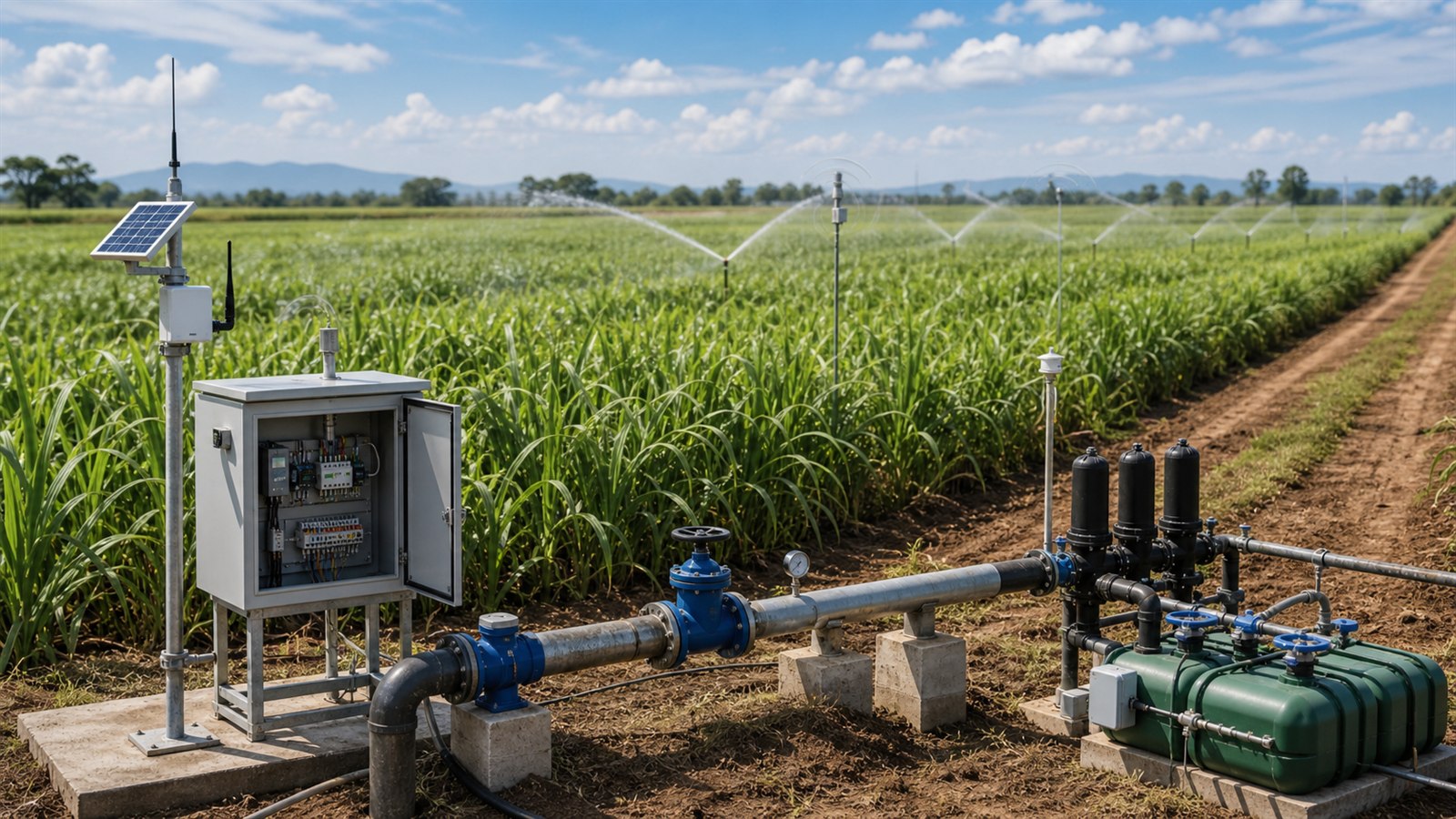
Modernizing industrial irrigation requires much more than automating valves. Efficient management of large agricultural areas depends on bringing hydraulic information, fertilizer dosing, energy, communications and field operations into one reliable platform. In late 2023, Electroshop developed an Ignition and MQTT solution to expand and update the irrigation system of a sugar cane operation.
The project had to control multiple sections ranging from 4 to 20 hectares, covering approximately 117 hectares in total. The solution needed to monitor pressure, flow and water and fertilizer doses while coordinating dozens of valves distributed across the field. The distance between devices and the agricultural environment called for a combination of local computing, long-range communications and a data architecture ready to integrate with higher-level systems.
The challenge: distributed control and useful data
In an installation of this size, centralizing every signal through conventional wiring is expensive and difficult to maintain. A system limited to discrete relay commands is also insufficient: operators need to see the status of each area, confirm actions, record process variables and identify abnormal conditions early.
The architecture also had to remain operational when corporate connectivity was unavailable. Critical control and data acquisition were therefore kept close to the process, while contextualized information remained available for supervision, reporting and enterprise integration.
Ignition Edge as the field platform
Ignition Edge Panel was selected as the central field operations platform. It runs the irrigation logic, communicates with local controllers and coordinates remote nodes. Its support for industrial protocols makes it possible to integrate auxiliary equipment without relying only on electrical contact interfaces.
The HTML5 interface provides authorized access from different devices and presents status information, alarms, trends and commands consistently. Local processing also enables scripts, history and reports without moving the entire computing workload to remote infrastructure.
MQTT and LoRaWAN across the field
Remote valve control was implemented with MQTT messaging. Field nodes communicate through LoRaWAN, a technology suited to sending small amounts of data over long distances with low energy consumption. Under the project conditions, the network achieved an approximate five-kilometer coverage radius, enough to connect the distributed irrigation areas.
A local MQTT broker distributes messages between Ignition Edge and the nodes. Incoming variables become operationally contextualized tags and can be retransmitted with Sparkplug through the Cirrus Link MQTT modules. This approach keeps the industrial namespace organized and makes it available to SCADA, ERP, analytics or data services without creating duplicate point-to-point integrations.
Operational data flow
- Ignition Edge calculates and executes irrigation sequences according to each area’s setpoints.
- The MQTT broker publishes commands and distributes responses from remote nodes.
- LoRaWAN devices operate the valves and report their status and related variables.
- The platform contextualizes information, generates alarms and stores the data needed for analysis and traceability.
- Higher-level systems receive structured information for supervision, reporting and decision-making.
Results and added capabilities
During 2024, the solution enabled controlled water and fertilizer dosing, pump monitoring and access to the most important operating variables. A georeferenced view compatible with GeoJSON data helped operators relate each device to its actual location in the field.
The platform also incorporated pump energy measurements, historical trends, exportable reports and weather data. Combining energy consumption with the volume of transported water produces specific-energy indicators that help assess pump efficiency and identify maintenance or operational improvement opportunities.
Cybersecurity by design
MQTT should not be exposed directly to the Internet or treated as secure by default. Industrial deployments should protect communications with TLS, individual authentication, topic-level authorization, managed certificates, network segmentation and restrictive firewall rules. Anonymous access should be disabled, the broker, Ignition and gateways should remain up to date, remote administration should be limited, and tested configuration backups should be maintained.
These controls reduce the attack surface and prevent easy integration from becoming a process risk. The architecture should separate local control from corporate connections and record relevant events for audit purposes.
A scalable foundation for industrial agriculture
The combination of Ignition Edge, MQTT, Sparkplug and LoRaWAN proved to be a flexible foundation for industrial irrigation automation. It brings computing closer to the process, preserves local operation and organizes data so it can be used at other levels of the business.
The same infrastructure can grow to include soil-moisture sensors, weather stations, level measurement, equipment diagnostics or optimization models. The result is not simply an irrigation controller, but an industrial platform designed to improve the use of water, fertilizer and energy.
This corporate editorial version is based on an original LinkedIn article by Jorge Gálvez.